
For more than a century, the story of Australia’s gold rush has been celebrated as a tale of prosperity, migration, and nation-building. Yet hidden beneath that history lies a largely overlooked environmental legacy: mercury pollution.
New research from Walhalla, Victoria, has revealed that mercury released during colonial-era gold mining continues to contaminate soils, waterways, and ecosystems more than 100 years after mining ceased.
A toxic legacy from the gold rush
During the nineteenth century, mercury was widely used to extract gold from crushed ore through a process known as amalgamation. The technique was effective but inefficient. Large amounts of mercury were lost to the environment during ore processing and gold recovery.
Historical records examined in our study show that between 1867 and 1889 alone, mining operations at Walhalla likely released between 2.6 and 34.4 tonnes of mercury into the environment. Mining continued for several decades after this period, suggesting total mercury losses were even greater.
At the time, there were no environmental regulations governing mining waste. Tailings, contaminated water, and mercury emissions were routinely released into surrounding landscapes and waterways.
Trees as environmental historians
One of the most innovative aspects of this research was the use of tree rings to reconstruct historical mercury pollution.
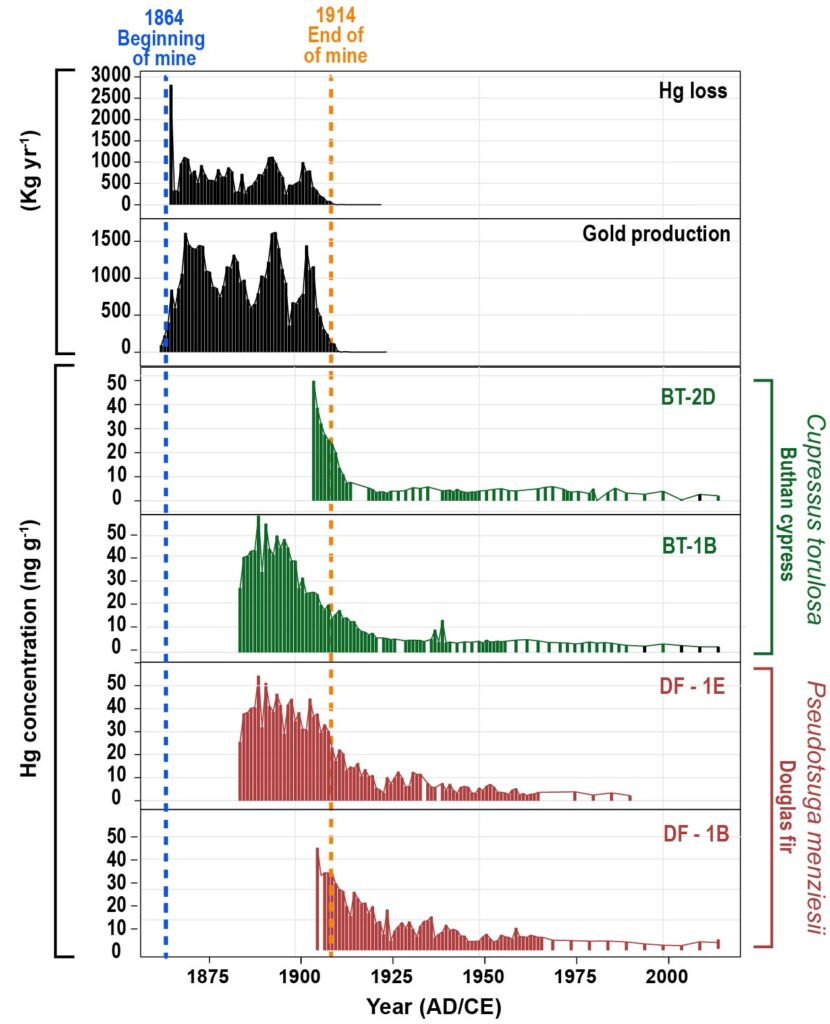
Scientists analysed annual growth rings from Bhutan cypress and Douglas fir trees planted in Walhalla during the mining era. Because tree rings form year by year, they can preserve a record of environmental conditions through time.
The results were striking.
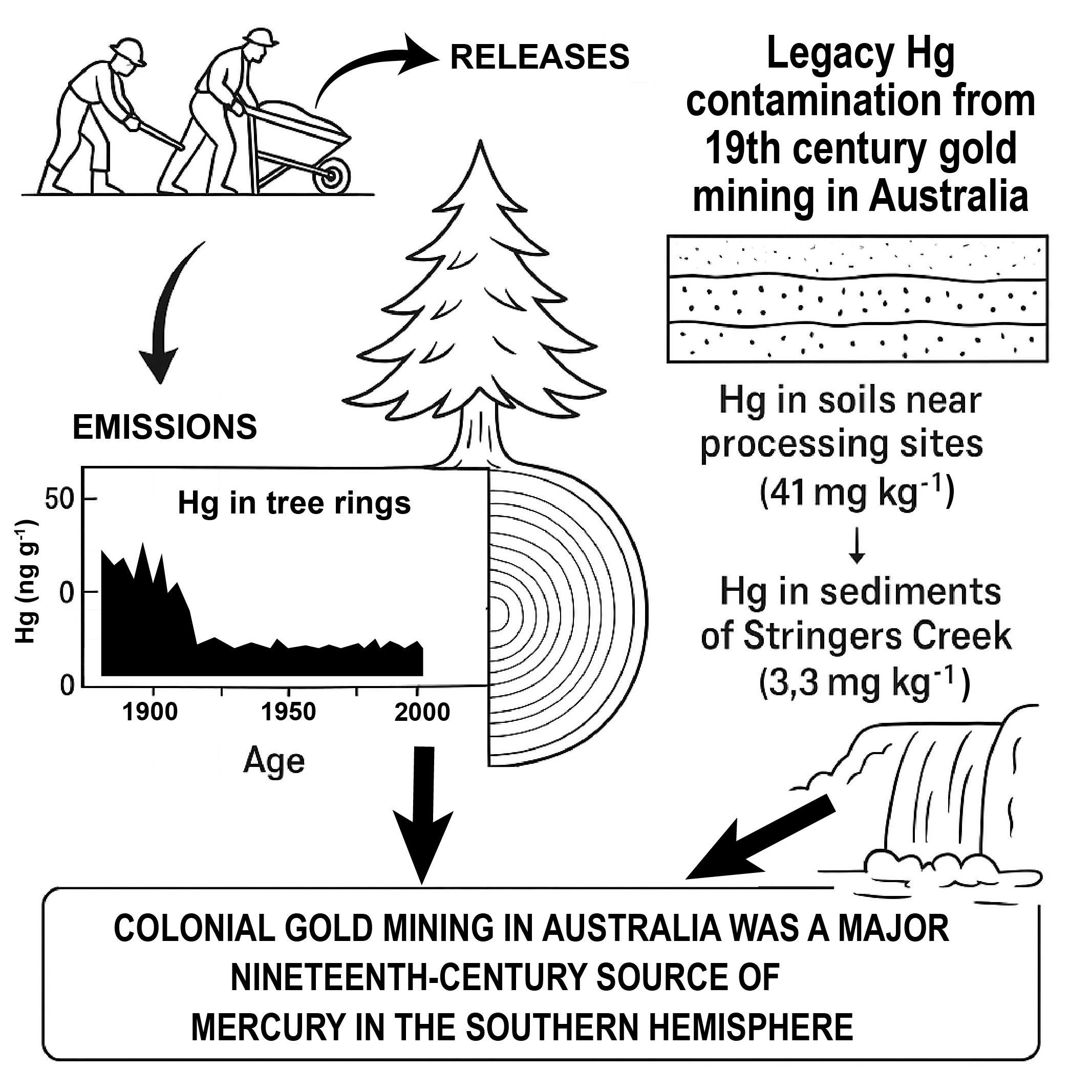
Mercury concentrations in tree rings increased dramatically during the peak mining period between approximately 1885 and 1914 (Figure 1). Mercury levels were around seven times higher than background concentrations measured after mining ceased.
This provides the first direct annual-scale record of colonial-era mercury emissions in Victoria.
The tree-ring record closely matched historical gold production records, creating a powerful link between mining activity and atmospheric mercury pollution.
Mercury remains in the landscape today
Although mining at Walhalla largely ended by 1914, the mercury has not disappeared.
Soils collected around historical ore-processing sites contained mercury concentrations averaging 41 milligrams per kilogram—around 2.5 orders of magnitude higher than natural background levels for the region.
Even more concerning were the results from Stringers Creek, which flows through the former mining district.
Sediment mercury concentrations exceeded Australian sediment quality guidelines throughout the creek. Many samples exceeded levels considered likely to cause toxic effects in aquatic organisms.
The highest concentrations were found not directly at the mining sites, but downstream near a waterfall where contaminated sediments have accumulated over decades of erosion and transport.
The methylmercury problem
Mercury becomes particularly dangerous when converted into methylmercury, a highly toxic form that accumulates in food webs.
Methylmercury readily biomagnifies, meaning concentrations increase as it moves up the food chain. Predatory fish, birds, wildlife, and humans can therefore be exposed to elevated levels.
Several sediment samples from Walhalla contained methylmercury concentrations among the highest reported globally. The highest values were recorded near the waterfall area, identifying a potential hotspot for ecological risk.
These findings demonstrate that historical mining pollution is not simply a legacy issue confined to the past. Mercury continues to cycle through modern ecosystems, potentially affecting environmental and human health.
Why this matters for Australia
Australia’s colonial gold rush transformed the country economically and socially. Yet the environmental costs of that transformation remain poorly understood.
Internationally, historical gold mining is recognised as one of the largest sources of legacy mercury pollution. In countries such as the United States, Canada, and parts of South America, extensive efforts have been made to identify and manage contaminated mining landscapes.
Remarkably, the Australian National Implementation Plan for the Minamata Convention on Mercury does not specifically address contamination from historical gold mining, despite the likelihood that these sites represent one of the country’s largest sources of legacy mercury pollution.
The findings from Walhalla suggest that many other historic goldfields across Victoria, New South Wales, Tasmania, Queensland, and Western Australia may also contain significant mercury contamination.
Looking ahead
The story emerging from Walhalla is clear: mercury released during colonial-era gold mining has not vanished. It remains stored in soils and sediments, continues to move through waterways, and can still be transformed into toxic methylmercury.
This research provides the first comprehensive “emission–tree ring–environment” evidence chain linking historical mining activities to present-day contamination in Australia.
Understanding where mercury persists, how it moves through landscapes, and what risks it poses is essential for developing effective remediation strategies and protecting communities and ecosystems.
As Australia works towards meeting its commitments under the Minamata Convention, legacy gold mining contamination can no longer remain invisible.
The trees of Walhalla have preserved the evidence. Now it is time to act on it.
Further reading
Schneider, L. et al. (2025). Legacy mercury emissions and releases from colonial-era gold mining in Australia. Environmental Pollution.
Twitter