
Why is mercury useful for environmental research?
Mercury is a naturally occurring chemical element found in rocks, soils, water and the atmosphere. Human activities, including mining, coal combustion and industrial processes, have substantially increased the amount of mercury circulating in the environment.
Mercury is of particular concern because some of its chemical forms, especially methylmercury, can accumulate in food webs and pose risks to wildlife and human health.
However, the same properties that allow mercury to move between the atmosphere, oceans, land and living organisms also make it useful for understanding environmental processes. Mercury can be transported over long distances, transformed through chemical and biological reactions, and retained in natural environmental archives.
These characteristics allow scientists to use mercury as a tracer: a substance whose distribution and chemical characteristics provide information about environmental sources, pathways and changes.
Importantly, using mercury as a scientific tracer does not require adding mercury to the environment. Researchers can study mercury already present in natural materials.
What can mercury tell us about the past?
Some natural environments preserve records of historical conditions. For example, lake sediments accumulate over time, with newer material gradually covering older layers. Peatlands similarly preserve organic material and chemical substances deposited over hundreds or thousands of years. Trees can also provide historical information through their annual growth rings.
Mercury retained in these archives can help scientists investigate changes in atmospheric deposition, industrial pollution and environmental processes. For example, studies in Australia have used mercury preserved in tree rings and lake sediments to reconstruct historical emissions from gold mining and copper smelting. These records can reveal pollution that occurred before environmental monitoring programs existed.
However, mercury records do not always reflect pollution alone. Changes in vegetation, erosion, soil development and the movement of organic matter can also influence mercury concentrations in environmental archives. Understanding these natural processes is essential for correctly interpreting what mercury records tell us about the past.
What are mercury isotopes, and why do they matter?
Mercury has seven naturally occurring stable isotopes. These are forms of the same chemical element that contain different numbers of neutrons.
Although mercury isotopes behave similarly in many respects, environmental processes can change their relative proportions. For example, chemical reactions involving sunlight can alter mercury isotope signatures. Other processes, including microbial transformations and interactions with environmental materials, can also influence these signatures.
Scientists measure these small differences using specialised analytical instruments. The resulting isotope patterns can provide clues about mercury sources and environmental pathways. For example, mercury that has undergone photochemical reactions in marine environments may have a different isotope signature from mercury deposited directly from the atmosphere.
By examining these differences, researchers can investigate how mercury moves through oceans, soils, vegetation and food webs. However, isotope signatures are not always unique to a particular source. Scientists therefore often combine mercury isotope measurements with other environmental indicators to strengthen their interpretations.
How can seabirds transport mercury from oceans to islands?
Seabirds provide an important connection between marine and terrestrial ecosystems. They obtain food from the ocean and return to islands to breed, rest and raise their young. During this process, they transport nutrients and other substances from marine food webs onto land, particularly through their guano.
Mercury is one of the elements that can be transferred through this pathway. Once deposited on land, mercury and nutrients from seabird guano can become incorporated into soils, vegetation and peatlands. Over many generations, repeated seabird activity may leave chemical signatures that are preserved in the environment.
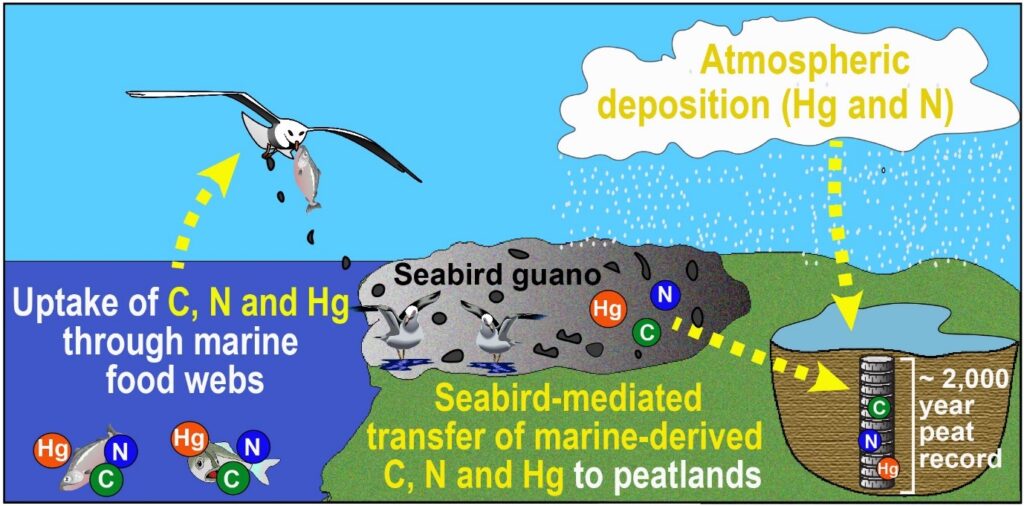
This raises an interesting scientific possibility: could mercury preserved in island peatlands help us understand where seabird colonies existed, when they declined and whether they subsequently recovered?
Can mercury reveal seabird history?
Modern seabird monitoring provides valuable information about population trends, breeding success and environmental threats. However, many monitoring programs cover only recent decades.
This creates a challenge for conservation because seabird colonies may have experienced substantial changes over much longer timescales. Climate variability, human exploitation, introduced predators, habitat disturbance and disease can all affect seabird populations. To understand these changes, scientists need information extending beyond direct observations.
Research at the Australian National University has demonstrated that mercury and carbon–nitrogen isotope records from Macquarie and Campbell Islands can reflect ecological disturbances and changes in the transfer of marine-derived material to terrestrial ecosystems.
Rather than relying on mercury alone, Mercury Australia researchers propose to combine several independent indicators:
- Mercury isotopes: to investigate the relative contributions of marine-derived, atmospheric and terrestrial mercury.
- Carbon and nitrogen isotopes: to identify marine nutrient inputs and changes in organic matter sources.
- Other chemical elements: to identify changes in erosion, mineral inputs and nutrient cycling.
Together, these indicators could help distinguish periods of stronger or weaker seabird influence from environmental changes unrelated to seabird activity.
Importantly, chemical records cannot automatically reveal the exact number of seabirds present in a colony. Without independent calibration, they are better suited to reconstructing relative colony influence, persistence and changes through time.
What could this tell us about seabird conservation?
Seabirds face increasing threats from climate change, introduced predators, habitat loss, exploitation and diseases such as avian influenza. Yet understanding whether current declines are unprecedented is difficult when monitoring records cover only a small part of a colony’s history.
Long-term environmental records may help answer important questions:
- Have seabird colonies experienced similar declines in the past?
- What environmental changes were associated with their disappearance or recovery?
- Are some colonies more resilient to disturbance than others?
By comparing reconstructed seabird histories with climate records, archaeological evidence and historical information about human activities, researchers may identify conditions associated with colony persistence, decline and recovery. The proposed research would also investigate whether these long-term records can improve models of future seabird vulnerability.
Such information could eventually help conservation managers identify priorities for monitoring, protection and restoration.
Does this mean mercury is beneficial to ecosystems?
Not necessarily. Mercury remains a potentially toxic element, and elevated mercury exposure can harm wildlife and human health. Its value as a scientific tracer comes from the information that researchers can obtain by measuring mercury already present in environmental materials.
This is an important distinction. Mercury is not being described as environmentally beneficial simply because scientists can use it to investigate ecological processes. Instead, its chemical behaviour provides an opportunity to understand environmental history.
In this way, the study of mercury can contribute not only to pollution assessment but also to broader questions about ecosystem functioning, biodiversity and conservation.
What our research shows
Research associated with Mercury Australia is demonstrating that mercury can provide information about environmental processes extending well beyond conventional pollution monitoring.
Reconstructing historical pollution
Studies of historical mining in Australia have used mercury preserved in tree rings and lake sediments to investigate emissions from nineteenth- and twentieth-century mining and smelting activities.
Related research: The hidden mercury legacy of Australia’s historical mines · Tree rings can reveal past mercury contamination
Understanding ecological disturbance
Research on Macquarie and Campbell Islands has shown that mercury accumulation and isotope signatures can change in response to ecological disturbances, including introduced species, vegetation changes and altered marine–terrestrial nutrient transfer.
Related research: PhD project: long range toxic metal pollution in Australia and the Sub-Antarctic Islands
Investigating historical seabird colonies
Building on these findings, a proposed research framework known as SIGMA (Seabird Influence Geochemical Multiproxy Assessment) aims to combine mercury isotopes with other chemical indicators to reconstruct long-term seabird colony influence. This research could establish a new application of mercury geochemistry in conservation science.
Further reading
- Schneider, M., Roberts, S., Sun, R., Saunders, K., Latimer, J., Haberle, S., Fallon, S., Hegarty, N., & Schneider, L. (2026). Colonisation-driven mercury cycling overrode industrial pollution in sub-Antarctic lakes. Research Square [Preprint].
- Schneider et al. (2019). Using tree rings to track atmospheric mercury pollution in Australia: the legacy of mining in Tasmania. Environmental Science & Technology.
- Schneider et al. (2025). The legacy of mercury contamination from colonial nonferrous mining in the Southern Hemisphere. Environmental Science & Technology.
- Proposed research: Forecasting seabird futures through 2,000 years of biogeochemical records. Australian Research Council Future Fellowship application FT270102070, submitted November 2026.
The key message
Mercury is an important environmental pollutant, but it is also a powerful scientific tracer. Its concentrations and isotope signatures can help scientists investigate historical pollution, understand environmental processes and reconstruct ecological changes that occurred long before modern monitoring began.
By combining mercury with other chemical indicators, researchers are exploring new ways to understand the history of seabird colonies and how ecosystems respond to environmental change.
Mercury may be a problem for the environment, but studying it can also help us understand and protect that environment.