
This research is the first study of Hg bioaccumulation in any Southern Hemisphere trees, the species Huon Pine (Lagarostrobos franklinii), endemic to western Tasmania, was found to be one of the most efficient bioaccumulators of mercury in the world. Essentially, the higher the mercury concentration in the atmosphere, the greater the amount of mercury taken up by the trees. Huon Pine’s ability to bioaccumulate mercury also makes it a good proxy for tracking historical Hg emissions in western Tasmania.
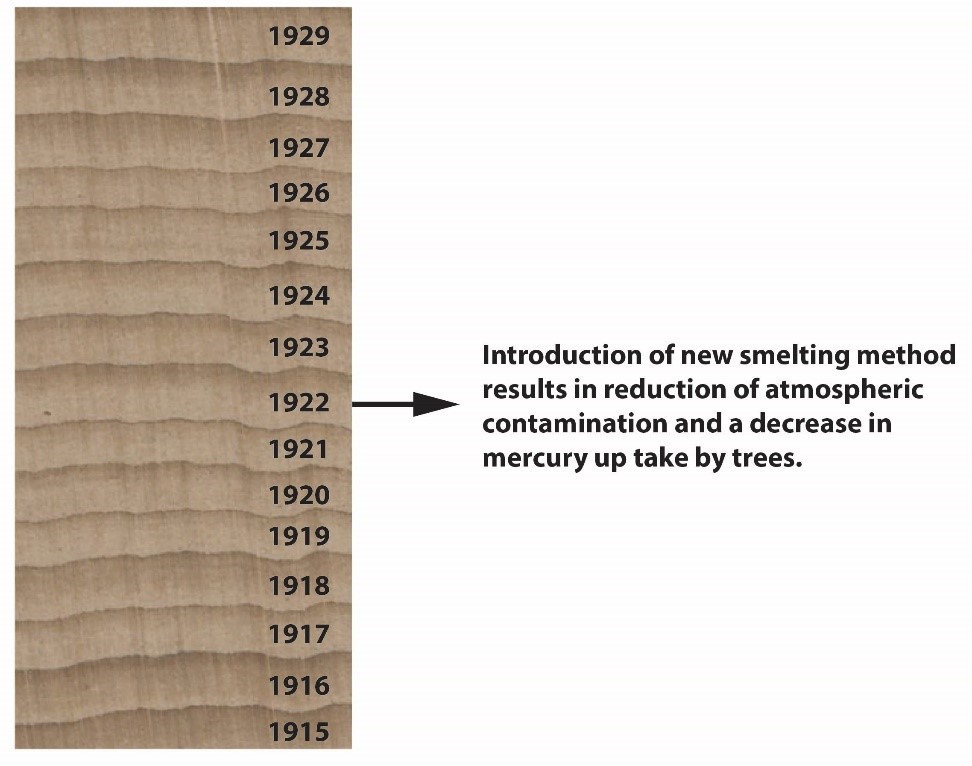
Mercury pollution due to former mining practices has left a lasting environmental legacy, with a significant reservoir of mercury stored in trees during the peak mining period in Queenstown. Changing concentrations in the annual tree rings over the past 150 years align with changes in mining practices in the region. Increasing concentrations of Hg coincide with the commencement of pyritic smelting for copper in Queenstown 1896, peaking between 1910 and 1920 when smelting was at its peak. Mercury concentrations began to decrease in parallel with the introduction of the floatation in the Queenstown smelter in 1922 (Figure 1), requiring only one small furnace instead of eleven large furnaces. Furthermore, in 1934 a dust collection apparatus was placed in the chimney of the smelter, this coinciding with the further decrease of mercury concentrations in Huon Pine.

Figure 1 – Temporal tree rings of Huon Pine.
Although it is not possible to simply remove past mercury emissions from the environment, the history of mercury contamination recorded in tree rings provides important lessons. Decreased uptake after installation and a decline in the number of smelters demonstrates the positive impact management decisions can have on the amount of mercury released into the environment.
In order to control mercury emissions globally, the United Nations Environment Programme (UNEP) developed the Minamata Convention on Mercury. The aim is to protect human health and the environment from the adverse effects of mercury. Australia has signed the Minamata Convention and anticipates ratifying it in the near future. Once ratified, Australia will be required to record sources of mercury and quantify emissions, including those from bush fires. To do this, the government must first be able to identify environmental reservoirs of mercury. Our study, the first of its kind in the Southern Hemisphere, shows that at least Huon Pine can be used to for this purpose, illustrating the potential of using long-lived trees in Australia to track and monitor Hg contamination in the environment over time. Additional work is required to determine what other tree species best track atmospheric emissions over time in other regions of Australia.
More information can be found on https://theconversation.com/mercury-pollution-from-decades-past-may-have-been-re-released-by-tasmanias-bushfires-114603