
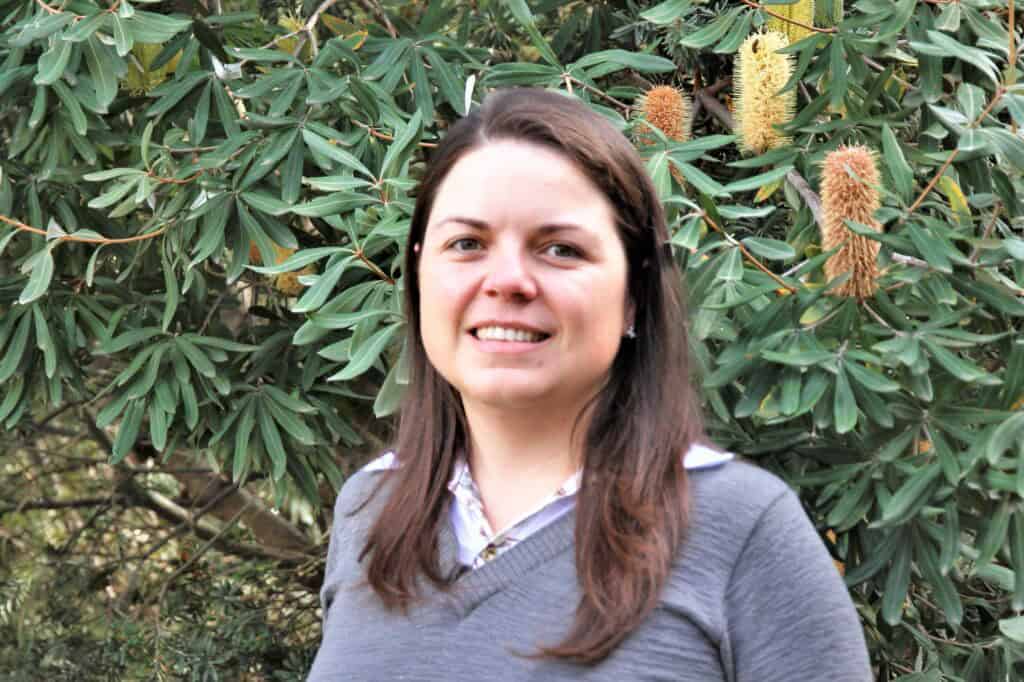
Larissa Schneider is an Associate Professor at the Australian National University at the Department of Archaeology and Natural History. Her research uses deposited lake sediments as archives of past mercury contamination to understand the natural cycle of mercury and how humans have increased mercury emissions since the start of the Industrial Revolution. The results of her research inform decision-making on mercury contamination in Australia.
A/Prof Schneider received her PhD from the University of Canberra, where she investigated the fate and transport of metals released by coal-fired power stations in estuarine environments in New South Wales. Following the completion of her PhD, she was awarded a prestigious Australian Research Council Discovery Early Career Researcher Award, which supported her appointment at the Australian National University (ANU). During this fellowship, she established a geochemistry research facility within ANU’s PalaeoWorks Laboratory, securing specialised instrumentation for mercury analysis and developing analytical methods for measuring mercury across a range of environmental matrices.
In addition to her scientific work, she has published articles on the interactions between science, policy and regulations on mercury, in particular focusing on efforts to better regulate mercury emissions by coal-fired power station in Australia. A/Prof Schneider is currently working on establishing the main climate drivers and anthropogenic events to affect mercury fluxes in the Southern Hemisphere.